
Retell AI vs Vapi for GoHighLevel Agencies: The Full 2026 Comparison
Comparisons
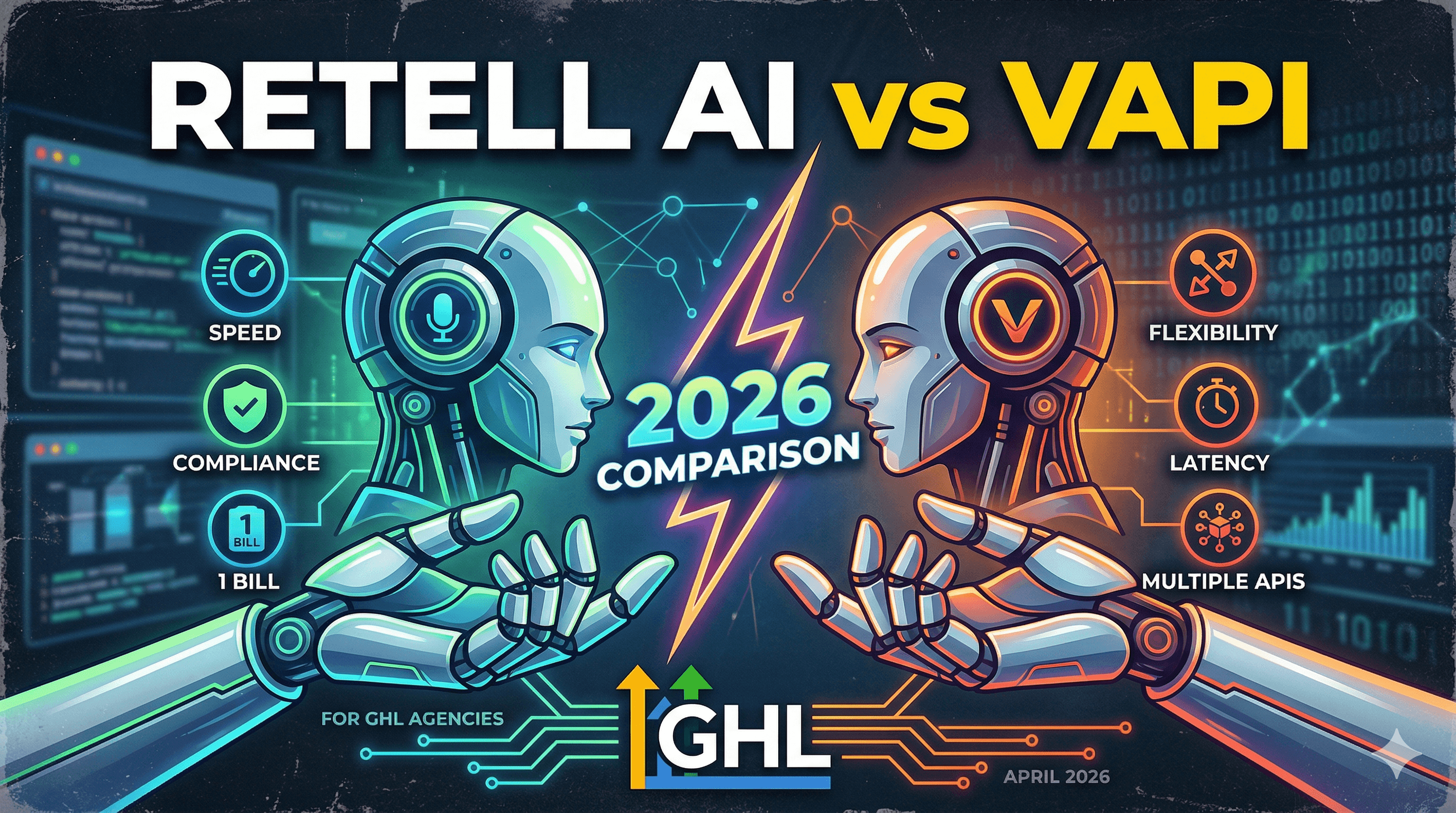
If you run a GoHighLevel agency and you are picking a voice AI engine in 2026, the decision usually comes down to two names: Retell AI and Vapi.
That is because a lot of the market now falls into one of three buckets:
Retell based setups
Vapi based setups
wrapper platforms built on top of one or both
The problem is that most Retell vs Vapi comparisons are written for developers starting from scratch. That is not how agencies actually live.
GoHighLevel agencies care about different things:
How fast can this go live for a client?
How much operational overhead does it add?
How does appointment booking work inside the CRM?
What does compliance look like in regulated verticals?
What happens when you are running several sub accounts at once?
That is the comparison that actually matters, so that is the one this article is built for.
TL;DR: which one should most agencies pick?
Pick Retell AI if you want the fastest path to a reliable production agent, cleaner compliance posture, fewer moving parts, and a setup that feels strong without requiring deep technical tuning.
Pick Vapi if you want more control over the underlying stack, are comfortable managing more providers, and have the technical depth to actually benefit from the extra flexibility.
Use both if your agency serves very different client types and you want the freedom to choose the better engine per use case instead of forcing one answer onto every client.
That is the short version. Now let’s get into why.
1. Pricing shape matters more than headline pricing
Both Retell and Vapi can look cheap when you only read the first number on the pricing page.
That is not how agencies should model cost.
What matters is the shape of the pricing once a real phone call is happening inside a production workflow.
Retell tends to feel simpler because more of the voice stack is packaged into one relationship. That means agencies usually get:
fewer vendors to manage
cleaner invoicing
less cognitive load when pricing clients
Vapi tends to feel more modular. That can be great for power users, but the tradeoff is obvious. Once you are combining orchestration, speech, telephony, models, and sometimes extra compliance costs, the true cost of the call depends more heavily on your configuration discipline.
For agencies that want predictability, Retell usually has the cleaner economic feel.
For agencies that want configurability, Vapi gives you more knobs to turn.
2. Retell usually wins on speed to production
This is one of the biggest practical differences.
Retell is usually the easier path from idea to working agent. It tends to be more approachable for teams that want to ship quickly, especially if the use case is receptionist flows, appointment booking, qualification, or standard outbound automation.
The reason is simple. Retell asks less of the operator.
You spend less time deciding which provider combination to use and more time getting the call flow right.
That matters a lot in agency work. Most agencies do not need the maximum possible architecture freedom. They need something that works, sounds good, and can be rolled out without turning every deployment into a mini infrastructure project.
On that front, Retell is usually the better default.
3. Vapi usually wins on control
Where Vapi becomes compelling is control.
It gives technical teams more freedom to shape the stack, choose providers, experiment with model combinations, and build more custom logic around how the agent behaves.
That means Vapi can be the better answer when:
the intake logic is unusually complex
you want tighter control over provider selection
you have engineering depth on the team
you are willing to trade simplicity for flexibility
The important part is that Vapi’s strength only matters if your team can actually use it. Unused flexibility is just extra complexity wearing a nice jacket.
4. Latency: raw speed vs consistency
Vapi is often discussed as the lower-latency option, especially in tuned setups. That is a real advantage when you have the technical control to optimize the configuration carefully.
Retell, however, tends to be more consistent out of the box.
For most GoHighLevel agencies, that matters more than bragging rights on the best possible benchmark. Clients do not buy “the fastest possible ideal setup.” They buy a call that feels natural and works reliably in production.
So the tradeoff here is not just “Which one is faster?”
It is “Which one is faster for the way your team actually operates?”
For a technical team tuning every layer, Vapi may win the latency race.
For a typical agency shipping fast and needing stable call performance, Retell’s consistency is often the more valuable advantage.
5. Compliance tilts the table toward Retell for regulated verticals
If you serve healthcare, insurance, finance, or other more regulated verticals, the compliance picture matters a lot.
This is where Retell often becomes the obvious choice.
Why? Because compliance readiness is much easier to work with when it is not an expensive side quest layered awkwardly onto the stack.
Vapi can still be viable, but if compliance requires extra cost and extra architecture decisions, that changes the economics fast for smaller or mid-sized agencies.
Retell tends to be more appealing here because it gives agencies a cleaner path into sensitive verticals without making them bolt a giant extra fee onto the operating model just to get started.
That does not mean every regulated client must use Retell. It means Retell is usually the safer default recommendation.
6. Appointment booking inside GoHighLevel
For agencies, the booking workflow matters more than abstract voice AI theory.
If the voice agent cannot book, confirm, qualify, route, and update the CRM cleanly, the demo does not matter.
Both Retell and Vapi can support booking workflows inside GoHighLevel when paired with the right integration layer.
The difference is usually operational:
Retell tends to be easier for straightforward booking flows
Vapi tends to shine more when the booking flow is part of a larger multi-step logic system
So if your client just wants a strong AI receptionist that qualifies and books, Retell is often the easier path.
If your client has a more complex intake tree with multiple stages or handoffs, Vapi can justify the extra setup burden.
7. Agency operations: one answer for all clients is usually the wrong answer
This is where most early-stage thinking breaks.
Agencies often assume they need to pick one engine forever and standardize everything on it.
That sounds clean. It is not always smart.
Different clients have different needs.
A dental office may care most about compliance, booking reliability, and low operational complexity.
A home services client may care more about speed-to-lead and aggressive call routing.
A more technical brand may need more custom function logic and orchestration flexibility.
That is why the best answer for agencies past the very early stage is often not “Retell or Vapi.”
It is “Retell for some clients, Vapi for others.”
That is a much healthier way to think.
8. Where Sympana Connector changes the equation
This is the part that makes the agency comparison different from a developer comparison.
When Retell or Vapi are run natively through Sympana Connector inside GoHighLevel, the CRM side of the workflow stays clean. You are not forcing calls through generic middleware every time you want to place a call, wait for a calling window, book an appointment, or route post-call data back into GHL.
That matters because middleware creates three problems agencies eventually hate:
more latency
more failure points
more per-execution cost stacking on top of the voice bill
Sympana Connector keeps the integration cost small and the operational model much cleaner. That means the actual Retell vs Vapi decision can stay focused on the voice engine itself, instead of getting distorted by whatever duct-taped automation layer someone put in the middle.
9. The decision matrix
Here is the simplest way to think about it.
Choose Retell if:
you want the easiest strong default
you care about faster rollout
you serve regulated industries
you want fewer provider relationships and a cleaner operating model
Choose Vapi if:
you have technical depth
you want more stack control
you are optimizing for custom orchestration and tuning flexibility
you are comfortable with extra provider management
Choose both if:
your client portfolio spans multiple verticals
different clients need different strengths
you do not want your whole agency constrained by a single engine choice
Final takeaway
For most GoHighLevel agencies in 2026, Retell AI is the better default recommendation.
It is easier to deploy, easier to reason about, stronger for compliance-sensitive work, and more likely to work well without heavy tuning.
Vapi is still an excellent option, especially for technical teams that want deeper control and are willing to manage a more configurable stack.
And for agencies that are growing across multiple client types, the smartest answer is often to use both and choose per deployment instead of pretending every client problem deserves the same engine.
Want the cleanest way to run either one inside GoHighLevel?
Use a native connector that lets you keep CRM workflows, booking logic, and post-call automation inside GHL instead of duct-taping your voice stack together with middleware and vibes.