
Database Reactivation with AI Voice Agents: The GoHighLevel Agency Playbook
GoHighLevel
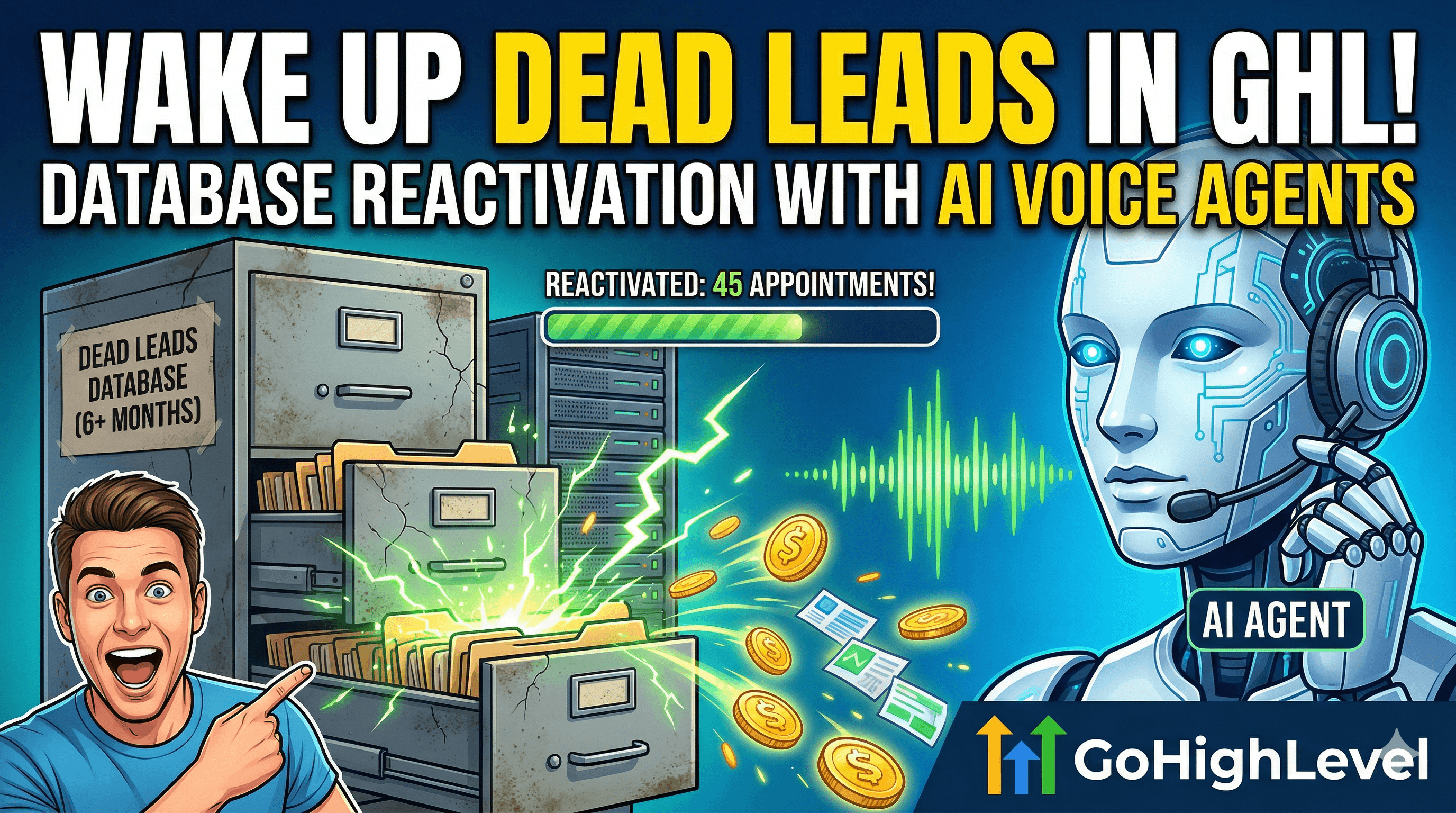
Most GoHighLevel agencies are sitting on revenue they already paid for and forgot about.
It is not sitting in this week’s inbound leads. It is sitting in the graveyard.
Old form fills. No-shows. Leads that asked for a quote and disappeared. Prospects that said “not right now” three months ago and were never touched again. The database is full of people who already raised a hand once, then drifted out of the active pipeline.
That is where database reactivation gets interesting.
And right now, it is one of the best use cases for AI voice inside GoHighLevel.
Why? Because agencies do not need another channel that creates more busywork. They need a way to pull real conversations, real appointments, and real revenue out of dormant contacts without forcing a sales rep to manually grind through 3,000 stale records.
That is exactly where AI voice agents shine.
When paired with a native workflow layer like Sympana Connector, an agency can build reactivation systems that call the right contact at the right local time, qualify interest, book appointments, and push the result straight back into GoHighLevel. No duct-taped middleware circus. No human rep manually chasing every dead lead. Just a cleaner machine for turning old CRM data back into pipeline.
Why database reactivation matters so much
Most client databases are bloated with sunk-cost opportunities.
The lead cost is already gone. The ad spend was already spent. The form fill already happened. The no-show already happened. The follow-up sequence already stalled out.
From the client’s perspective, those contacts often feel dead.
From an agency perspective, that is exactly why they are valuable.
You are not trying to invent demand from scratch. You are re-engaging people who already demonstrated intent once. That makes database reactivation one of the most attractive offers an agency can sell, because every booked appointment feels like found money.
It is also easier to pitch than most acquisition services.
You are not asking the client to trust you with new ad spend. You are telling them, “You already paid for this data. Let’s finally monetize it properly.”
Why voice works better than tired SMS blasts
Email reactivation and SMS reactivation still have a place. But most clients have already squeezed those channels into the ground.
The average dormant lead has seen enough “just checking in” messages to last several lifetimes.
Voice changes the dynamic.
A phone call creates a moment that text usually does not. The contact has to decide in real time whether they are still interested, whether they want to book, whether they want a callback, or whether they want out. That is useful because reactivation is really a sorting problem. You are trying to separate the still-interested contacts from the truly dead ones as efficiently as possible.
Voice also compresses the funnel.
With SMS, a lead may reply, then wait, then ask a question, then go cold again before anyone actually gets them on the calendar. With an AI voice agent, qualification and booking can happen inside the same conversation. That shrinks the gap between “interested” and “booked,” which is where a lot of revenue leaks out in ordinary follow-up systems.
And for agencies, that matters because booked appointments are much easier to report, retain on, and sell around than vague engagement metrics.
What a good reactivation campaign actually targets
Not every cold lead belongs in the same sequence.
Before a single call goes out, segment the database properly inside GoHighLevel.
A practical structure looks like this:
30 to 60 days cold. Recent no-shows, recent quote requests, recent unresponsive form fills. Usually the highest-quality segment.
60 to 180 days cold. Leads that had real intent but stalled. Good reactivation pool, usually with lower pickup and lower conversion than the warmer segment.
180 plus days cold. Older opportunities that still might be worth working, but should not be expected to behave like fresh leads.
Also remove the obvious landmines before launch:
do-not-call contacts
people who opted out
contacts already sitting in an active sales conversation
junk or obviously invalid records
Start with the warmest dormant segment first. That is where you prove the economics fastest.
The playbook: how to build this in GoHighLevel
Step 1. Build a simple agent, not a bloated one
This is where a lot of people get cute and ruin the campaign.
A reactivation agent does not need 47 personality branches and a five-layer objection tree. It needs to do a few basic jobs well.
Open naturally.
Reference the original reason the contact entered the CRM.
Find out whether interest still exists.
Offer the next step immediately if interest is still there.
Exit cleanly if the contact is not interested.
That is enough.
A strong opener sounds human, direct, and short. Something like: “Hey Sarah, this is Ashley from Midtown Dental. You reached out a while back about getting in for a consult. Do you have a quick second?”
Simple wins here. Long robotic intros kill response quality fast.
Step 2. Connect the voice provider to the CRM properly
The reason a lot of agencies never scale voice reactivation is not the agent itself. It is the glue layer around it.
They end up running calls through a mess of webhooks, middleware automations, patch scripts, and brittle handoffs between the voice stack and the CRM. The first client works. The third client gets messy. The tenth client becomes a support ticket generator with a phone number.
This is where Sympana Connector matters.
Instead of forcing agencies to build the connection between GoHighLevel and Retell AI or Vapi from scratch, Sympana gives them a native path inside GHL. The provider connects into the sub-account, the voice agent becomes available inside workflow actions, and the reactivation logic can stay much closer to the CRM where it belongs.
That matters operationally because the more native the workflow is, the less likely the system is to break in weird expensive ways later.
Step 3. Use a real calling-window step
Calling dead leads at the wrong hour is one of the dumbest ways to torch a campaign.
If the workflow is going to run across multiple regions, use a calling-window step that respects the contact’s local timezone. In Sympana, the built-in wait-until-calling-window action is one of the highest-leverage pieces in the whole system. It improves pickup quality and helps keep the operation cleaner from a compliance standpoint.
It is not a sexy feature. It is just one of those things that separates adult systems from toy systems.
Step 4. Place the call with the right data
When the workflow fires the call, the agent should receive enough context to sound like it belongs in the conversation.
That usually includes:
first name
service interest or original lead source
date or timeframe of original inquiry
any relevant custom-field context that helps the opener feel grounded
If the client has a number pool, local presence can help here too. Dormant leads are still more likely to answer a number that looks plausibly local than a random out-of-state caller ID.
Step 5. Branch the automation after the call completes
This is the part that turns a voice campaign into a real service.
Once the call ends, the workflow should branch based on what actually happened.
A clean version looks like this:
If the contact booked, tag them clearly and move them into the client’s normal pre-appointment flow.
If the contact showed interest but did not book on the call, send the booking link quickly while the conversation is still fresh.
If the contact said they are no longer interested, tag that outcome and stop burning them with repeat reactivation attempts.
If the call hit voicemail or was missed, schedule the retry logic intelligently instead of hammering the same pattern again.
This is where Sympana’s call-completed trigger becomes especially useful inside GoHighLevel, because the post-call analysis can drive the next branch natively instead of forcing the agency to reconstruct everything outside the workflow builder.
Step 6. Hand the hot ones to a human fast
AI should not own every conversation all the way to the grave.
If the call surfaces high intent, unusual objections, a complaint, a pricing question the agent should not wing, or a complex booking scenario, route it to a human immediately.
This can be as simple as pushing a notification with the call summary, contact record, and direct number to the sales rep or closer.
That handoff is one of the reasons reactivation can become a premium offer. The AI does the filtering. The human only steps in where the economics justify it.
What results should agencies expect?
Exact performance depends on the list quality, vertical, offer, script, and age of the database. Anyone promising identical results across every campaign is selling theater.
But the economics are still usually attractive.
A healthy reactivation list often produces enough conversations to justify the whole campaign long before the list is exhausted. And because the contacts are already in the CRM, the cost basis is wildly better than net-new lead generation.
This is why agencies like the offer so much. You can often create visible pipeline movement from a list the client mentally wrote off already. That makes the service feel fast, concrete, and easy to understand.
Even modest appointment lift can look strong when the underlying data cost is already sunk.
How to sell database reactivation as an agency offer
The positioning is straightforward.
You are not pitching some magical AI future. You are pitching recovered revenue.
A clean offer sounds something like this:
“You already have hundreds or thousands of old leads sitting inside your CRM. We build an AI voice reactivation system that calls them, qualifies interest, books the ones who are still ready, and routes the hot ones back to your team. You are monetizing leads you already paid for instead of letting them rot.”
That is an easy story for a client to understand.
It is also a good retention lever for the agency, because once the workflow is dialed in and appointments start coming back into the pipeline, it becomes much harder for the client to view the agency as optional.
Common ways to package it include:
a one-time setup fee plus monthly management
a monthly reactivation retainer
a hybrid model with baseline management plus performance upside
The exact pricing varies by niche and agency model, but the service sells well because the value proposition is tied to existing missed opportunity rather than speculative new growth.
Where most agencies trip themselves up
The failure modes are boring and predictable.
Bad segmentation. They dump every old contact into the same campaign and act surprised when the results feel muddy.
Overbuilt prompts. The agent turns into a philosophical robot instead of a booking machine.
Weak post-call logic. The call ends, but the CRM does not know what to do next.
No human escalation path. The AI catches a hot lead and nobody picks it up fast enough.
Sloppy compliance posture. They treat old data like universal calling permission and discover the hard way that regulators are not impressed by creative optimism.
That last one matters.
A quick word on compliance
Database reactivation is powerful. That does not make it permissionless.
Agencies still need to think seriously about consent, opt-outs, do-not-call handling, local calling windows, and whether the client has the right to contact the records they want to work.
The safest mindset is simple: if the consent story is weak, clean it up before you scale the campaign.
Sympana can help on the workflow side with things like calling windows, operational controls, and post-call tracking, but the agency still has to make sure the client’s data and outreach practices are defensible.
This article is for informational purposes only and is not legal advice. Agencies should review their calling practices and consent standards with qualified counsel where appropriate.
Why this is such a strong fit for Sympana Connector
Database reactivation is not just about placing calls. It is about running a whole loop cleanly:
find the right dormant segment
call at the right time
use the right agent and number strategy
book or qualify in the conversation
branch the workflow based on what happened
hand off hot conversations to a real human when needed
That is exactly the kind of use case where a native GoHighLevel connector has real leverage.
Sympana Connector is strong here because it keeps the voice provider layer, the call logic, and the CRM automation closer together. Agencies can run Retell AI or Vapi inside a more workflow-native model instead of building every reactivation campaign like a custom plumbing project.
Final takeaway
Database reactivation is one of the simplest high-ROI AI voice offers an agency can sell right now.
Not because it sounds futuristic. Because it monetizes an asset the client already owns.
If a client has dormant leads inside GoHighLevel, there is a real chance those contacts can still produce appointments and revenue with the right outreach system. AI voice makes that outreach more scalable. Sympana Connector makes it much easier to operationalize inside the CRM.
The agencies that understand this will not just sell “AI calling.” They will sell a cleaner system for turning forgotten contacts back into pipeline.
Want to build database reactivation campaigns inside GoHighLevel without stitching together a brittle middleware stack?
Install Sympana Connector, connect Retell AI or Vapi, and turn dormant leads into booked conversations again.