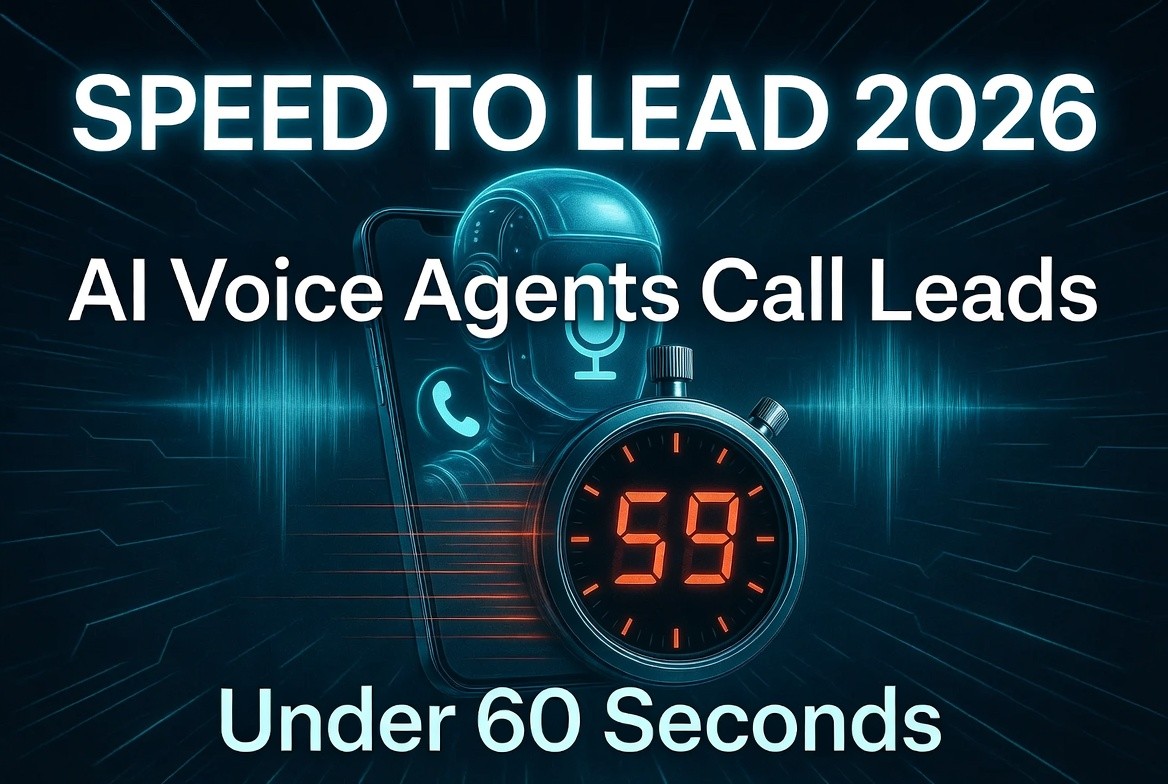
Speed to Lead in 2026: How AI Voice Agents Call Your Leads in Under 60 Seconds
AI Voice
You paid for the lead.
The form came in. The phone should have rung. Instead, nothing happened.
Maybe your rep was on another call. Maybe it was after hours. Maybe somebody planned to follow up “in a few minutes” and those few minutes quietly turned into an hour.
By then, the lead was already talking to somebody else.
That is the speed to lead problem. And in 2026, it is still one of the biggest silent killers of campaign ROI.
Everyone already knows fast follow up matters. That is not the issue. The issue has always been execution.
You cannot realistically have a human ready to call every new lead within 30 to 60 seconds, twenty four hours a day, across multiple campaigns, sub accounts, and clients.
But an AI voice agent can.
The real cost of slow follow up
Speed to lead sounds like one of those ideas everybody agrees with and then ignores.
That is expensive.
The longer a lead waits, the worse everything gets. Contact rates go down. Qualification rates go down. Booking rates go down. Return on ad spend starts leaking for reasons that have nothing to do with the offer, the landing page, or the ad creative.
Here is what that looks like in the real world.
Say you are a GoHighLevel agency running Facebook ads for a dental practice. You generate 50 leads per week at $20 each. That is $1,000 in ad spend.
If follow up is happening two hours later, booking performance will usually be weaker than it should be, even if the leads themselves are solid. If you compress response time to under 60 seconds, the lead gets called while intent is still hot. They still remember the ad. They still remember why they filled out the form. They have not mentally moved on yet.
That is where the gain happens.
Same traffic. Same ad spend. Same offer. Better timing.
And better timing often produces what feels like a better lead source, when really the system just stopped fumbling the handoff.
What AI voice changes
There is a lot of hype in AI voice right now, so let’s make this simple.
An AI voice agent is software that can make or receive phone calls using a natural sounding voice, understand what the person says, respond in real time, and take action during the call.
For speed to lead, that matters because the AI does not need to “get around to it.”
The moment the workflow fires, the call goes out.
That means:
no waiting for a rep to become available
no gap between form submission and first contact
no after hours dead zone
no inconsistency in how the lead gets handled
Platforms like Retell AI and Vapi are now strong enough to handle the kind of early stage sales conversations that used to require a human just to keep the funnel moving. They can qualify, ask follow up questions, respond to common objections, and in many cases book the appointment directly during the same call.
That changes speed to lead from a staffing problem into a systems problem.
Why this matters so much for GoHighLevel agencies
If you are an agency, speed to lead is not just a client results issue. It is a retention issue.
When a client says “the leads are bad,” sometimes the leads are not bad at all. Sometimes the follow up was just too slow.
That matters because clients rarely diagnose this correctly. They do not usually say, “Our operational lag between submission and contact is degrading conversion efficiency.” They say, “The campaign is not working.”
And then they cancel.
Fast AI follow up can change that equation.
If a lead submits a form and gets a call in under a minute, the campaign feels more responsive, the client sees more booked appointments, and the agency gets credit for performance that was always available but never captured.
This is one of the easiest ways to create a visible lift without increasing ad spend.
Where GoHighLevel’s native Voice AI starts to hit limits
GoHighLevel’s own Voice AI is useful for lighter use cases.
But if you are serious about running speed to lead workflows at scale across multiple client accounts, more complexity shows up fast.
Agencies doing real volume usually care about things like:
higher outbound capacity
calendar booking during the call
smarter routing and agent selection
better post call data handling
tighter workflow control
the ability to plug into stronger voice providers like Retell AI or Vapi
That is exactly the gap Sympana Connector is designed to solve.
What the speed to lead workflow actually looks like
When the stack is set up properly, the workflow is simple:
Lead submits form → GoHighLevel workflow triggers → Sympana Connector places the call → Retell AI or Vapi calls the lead → AI qualifies and books → GoHighLevel updates the record and sends follow up
That is the core loop.
And it happens fast.
A real implementation usually includes more than just the call itself. It includes things like:
contact field mapping
dynamic variables passed into the AI prompt
calendar access for live booking
post call summaries written back into GHL
pipeline stage updates
tagging and branching based on call outcome
confirmation SMS or email after booking
The point is not that AI makes the call.
The point is that the whole handoff from lead submission to booked appointment can happen with very little delay and very little manual work.
Why Sympana Connector has an advantage over middleware
Before native integrations like Sympana Connector, most teams had to use Make, Zapier, or n8n as the glue between GoHighLevel and voice AI platforms.
That worked, but it came with the usual software circus:
extra accounts
extra costs
more places for variables to break
more technical debt
more things to debug when something fails
Sympana Connector takes a more direct route.
It is a native GoHighLevel Marketplace app that connects GHL directly to Retell AI and Vapi. That means agencies can build voice workflows inside the environment they already live in instead of duct taping together external tooling just to make a lead get called quickly.
That matters because speed to lead systems need reliability. A “mostly works” workflow is not good enough when every missed trigger means wasted ad spend.
What Sympana Connector adds to the workflow
For speed to lead, Sympana Connector gives GoHighLevel users tools that make the system much more practical to run at scale.
That includes native support for:
Place Call actions for instant outbound AI calling
smart selection logic when you need better number or agent routing
Wait Until Calling Window for timezone aware compliance
dynamic variable mapping so the AI already knows who it is calling and why
Call Completed triggers for post call automations
calendar and appointment actions so the AI can actually close the loop
post call summaries and outcome data sent back into GHL
This is the difference between a voice demo and a real operational system.
AI voice agents versus human callers
Let’s keep this honest.
AI is not better than humans at everything. That would be a stupid claim.
But for speed to lead, AI has some brutally obvious advantages.
Where AI wins
response time: instant or near instant follow up
availability: nights, weekends, and after hours do not matter
consistency: every lead gets the same first touch process
cost: far cheaper per call than staffing human callers at scale
scalability: ten leads or five hundred leads does not create hiring pressure
Where humans still win
complex emotional conversations
nuanced objection handling
relationship building in higher ticket sales
That is why the strongest setup is usually not AI instead of humans.
It is AI for the first touch, qualification, and booking, then humans for the calls that actually need human judgment.
That gives you the speed advantage without pretending every part of the sales process should be automated.
How agencies are turning this into recurring revenue
This is where the operator brain should wake up.
Speed to lead AI is not just a performance tool. It is also a service line.
Agencies are packaging this as:
AI receptionist offers
speed to lead calling systems
missed call follow up automation
full inbound and outbound AI calling packages
Why does this sell so well?
Because the client can feel it.
If bookings improve, if leads get called faster, if the front desk load drops, and if attribution is easy to see inside GoHighLevel, this becomes one of the stickiest services an agency can offer.
Once a client watches their speed to lead gap collapse and their booking rate rise, they stop seeing this as an experiment. They start seeing it as infrastructure.
Getting started fast
If you are already inside GoHighLevel, you do not need a six week implementation plan just to test this.
The basic path is straightforward:
Install Sympana Connector from the GoHighLevel Marketplace
Connect Retell AI or Vapi
Create a speed to lead voice agent
Build a workflow triggered by form submission
Use Place Call to trigger the outbound call immediately
Add post call workflows for booking, tagging, and follow up
Test it with dummy leads before sending traffic
You can get the core loop running quickly. Then you refine the script, the booking logic, the calling windows, and the downstream automations from there.
The agencies that call first will win
The speed to lead math has been obvious for years.
What changed is the execution layer.
AI voice agents make it possible to follow up in under 60 seconds at a level of consistency and cost efficiency that human teams simply cannot match at scale.
That means agencies that implement this well will have a real advantage:
better campaign performance
better client retention
higher margins on AI calling services
a cleaner answer when clients ask how to improve conversions without spending more on ads
Sympana Connector makes this much easier to build inside GoHighLevel because it removes the middleware mess and gives agencies a direct path to operational speed.
Your competitor does not need better ads to beat you.
They just need to call the lead first.
Want to build AI speed to lead inside GoHighLevel?
Install Sympana Connector, connect Retell AI or Vapi, and start calling leads while intent is still hot.